Spring is in full swing here in the south and I am loving it. There is so much natural beauty here year-round but spring time is special. That is because it is both fleeting and spectacular. I need this combination like a slap in the face.
And how I need that slap in the face! I find that I get too busy, too wrapped up in the rat race to stop and appreciate life.
The surprising beauty of a redbud tree with its purple flowers peeking through a mass of larger trees, or the blazing white flowers of a dogwood hiding in the forest always catches my attention. Yet other patches of scenery occasionally catch my attention throughout the year. What makes spring special, and what slows me down and forces me to pay complete attention, is the fact that it is fleeting.
I know that the redbud, crabapple, or dogwood flowers will be there for only a few weeks. Then I have to wait a whole year before I can see them again. That makes me stop. I have to enjoy them right now, at this moment.
And it strikes me: shouldn't I do this with all things? Shouldn't I stop and thoroughly enjoy the laughter of my son, or the hug from my daughter, or the peace that comes after everyone is in bed and all the chores are done for the night? Rather than rushing onto the next thing on my list as I am prone to do.
So I am thankful for that brief, intense beauty that comes in spring. And I will be praying that I can live my life in a manner similar to how I appreciate springtime in the south.
Journeying through ADHD with non-traditional methods and having fun developing healthy dishes for kids with food sensitivities.
Thursday, April 3, 2014
Sunday, March 30, 2014
Physically Active Learning
I have been taking some education courses lately. This was a report I did for one of them that I thought you might find interesting.
Physically
Active Learning: A practical solution for increased learning?
I
first became interested in physically active learning due to my
interaction with attention deficit/hyperactivity disorder (ADHD). I
have a child with ADHD and know how hard it is for her to sit still
and accomplish a task. She has to get up, take breaks, and move
around in order to concentrate on an academic task. Yet in schools I
observed the common practice of making a child sit out of recess if
they had not finished some instructional work. On an intuitive level
this seemed counterproductive and I wanted to explore whether there
was some science that connected exercise with learning. As I dug
into the research I came across the idea of physically active
learning in schools.
Physically
active learning came into vogue in the early 2010s1,2,
partly as a reaction to new research linking exercise and brain
function and partly as a reaction to increased concerns over obesity
and inactivity. Physically active learning is the idea that moderate
physical activity, either before or during learning sessions,
increases memory and executive brain functions1,2.
Physically active learning sounds wonderful, but is it really
necessary and/or practical for schools today?
Physically
active learning is not the kinesthetic learning that is presently
being used in schools. Though physically active learning and
kinesthetic learning do overlap to some degree, they are different in
philosophy and practice. Kinesthetic learning3,4
is a specific learning style that may help certain individuals to
increase their ability to retain information. It relies on some form
of psychomotor activity, whether as small as moving blocks at a desk
or as large as dancing around a classroom, that is tied to the
subject being taught. In contrast physically active learning applies
more broadly to the population as a whole. All individuals
experience a change in brain function when they exercise5,6.
In addition the physical activity associated with physically active
learning is always whole body exercise, not small fine motor skills
activities. And finally the physical activity in physically active
learning is not necessarily associated with the subject being taught.
It
has long been known that there is a link between physical activity or
fitness levels on both brain structure and brain function7.
For example, two studies that looked at kids 9-10 yrs of age found
that those children who were more fit had larger basal gangli and
hippocampi, areas of the brain that control attention and memory8.
Exercise has also been shown to increase the production of
neurotropic factors, key elements to establishing new memories14,15.
Furthermore studies have found a correlation between fitness and
academic achievement9,10.
Even when academic instructional time is decreased to provide for
more physical activity such as PE, academic test scores do not go
down1,
9.
However
despite these results, there has been a steady decrease in movement
and PE in schools as they attempt to keep up with mandates such as No
child left behind. A 2013 bulletin from the Institute of Medicine
reports that half the administrators of schools decreased PE time
since 200111.
This is despite the fact that rates of obesity in US children have
doubled in the past 30 years, which brings along a whole host of
problems related to health and self image12.
Even at schools that still have PE, it is not uncommon for children
to be disciplined for classroom infractions by being forced to sit
out of PE or recess. This is especially common for children who are
naturally active, like ADHD children, who create frequent disruptions
in the classroom. In the belief that they need to make children
concentrate harder on the material at their desks in order to raise
test scores, educators may actually be holding back children from
reaching their optimal performance when it comes to academic
progress. This is why physically active learning techniques are so
important.
Physically
active learning links small amounts of moderate exercise with direct
changes in the brain, and these changes are thought to lead to an
increase in the ability of an individual to learn. A typical
physically active learning study will have children or adults
exercising for 20 minutes or resting for 20 minutes, followed by a
study time or a testing time. These studies have shown that moderate
exercise, such as walking or cycling for 15-30 minutes, increases
memory, attention, and problem-solving in children13.
One study looked at 20 minutes of stationary biking during a
learning session of foreign words14.
There
was a significant increase in retention for those who participated in
exercise compared to those who didn't. But what is even more
exciting was that this improvement was most enhanced for those people
who were “low performers”, ie those who had the most trouble
remembering the words. In a study of children in Northeast Kansas
public schools 16,
teachers were taught how to implement physically active learning
(called PAAC) and achieved at least 40 hrs per month of physical
activity within the class. This led to decreased BMI among the
students and increased reading, math, and spelling test scores.
Other reports of the benefit of physically active learning are more
anecdotal. In a Connecticut school kids crab-walk from place to
place and report better attitudes and retention17.
A Portland High School teacher uses musical chairs in her classroom,
which keeps the students more engaged and focused17.
From all of these studies it is evident that physically active
learning exercise is beneficial to students.
In
today's climate of shrinking PE time, more sedimentary lifestyles,
ADHD and increasing rates of obesity, physically active learning is
worth considering for the classroom. Unfortunately few teachers
implement physically active learning in their classrooms. Some ways
to incorporate physically active learning into a classroom include:
- short breaks of jumping jacks
- switching desks in the middle of instruction
- running team relay races where words must be put in the correct place on a diagram/chart in order for the racer to go back to their team
- playing musical chairs with true/false statements. When a false statement is said, the students scramble for the chairs.
- dances that incorporate lessons (see crystal structure dance and mitosis dance)
- disciplining kids by making them walk/run a track during PE or recess, rather than sitting still
Furthermore
there are some webpages that have other ideas of physically active
learning techniques:
- http://www.pelinks4u.org/articles/erwin0610.htm
References:
- Study: Physical activity can boost student performance, downloaded March 2014 from http://usatoday30.usatoday.com/news/education/2010-04-14-letsmoveinschool15_ST_N.htm
- Phys Ed: Can Exercise Make Kids Smarter? downloaded March 2014 from http://well.blogs.nytimes.com/2010/09/15/phys-ed-can-exercise-make-kids-smarter/?_php=true&_type=blogs&_r=0
- Learning Styles, downloaded March 2014 from http://cft.vanderbilt.edu/guides-sub-pages/learning-styles-preferences/ ;
- Learning Styles, downloaded March 2014 from http://www.redwoods.edu/Departments/Distance/Tutorials/LearningStyles/LearningStyles_print.html
- The influence of exercise on cognitive abilities., Gomez-Pinilla F1, Hillman C. , Compr Physiol. 2013 Jan;3(1):403-28. doi: 10.1002/cphy.c110063.
- Study Finds Aerobic Exercise Improves Memory, Brain Function and Physical Fitness , downloaded March 2014 from http://www.brainhealth.utdallas.edu/blog_page/study-finds-aerobic-exercise-improves-memory-brain-function-and-physical-fi
- The Effects of Aerobic Activity on Brain Structure, Adam G. Thomas,1,2,* Andrea Dennis,2 Peter A. Bandettini,1,3 and Heidi Johansen-Berg2, Front Psychol. 2012; 3: 86.
- Phys Ed: Can exercise make kids smarter? By Gretchen Reynolds downloaded March 2014 from http://well.blogs.nytimes.com/2010/09/15/phys-ed-can-exercise-make-kids-smarter/?_php=true&_type=blogs&_r=0
- Brain boost: Sport and physical activity enhance children’s learning by Dr Karen Martin, School of Population Health, The University of Western Australia May 2010, downloaded March 2014 from http://www.dsr.wa.gov.au//assets/files/Research/Brain%20boost_emailer.pdf;
- How Physical Activity Can Help Kids Do Better in School, downloaded March 2014 from http://remakelearning.org/blog/2013/10/01/how-physical-activity-can-help-kids-do-better-in-school/
- Educating the Student Body Taking Physical Activity and Physical Education to School, downloaded March 2014 from http://www.iom.edu/~/media/Files/Report%20Files/2013/Educating-the-Student-Body/EducatingTheStudentBody_rb.pdf
- Childhood Obesity Facts, CDC, downloaded March 2014 from http://www.cdc.gov/healthyyouth/obesity/facts.htm
- Physical Activity May Strengthen Children's Ability To Pay Attention, downloaded March 2014 from http://www.sciencedaily.com/releases/2009/03/090331183800.htm
- Physical Exercise during Encoding Improves Vocabulary Learning in Young Female Adults: A Neuroendocrinological Study Maren Schmidt-Kassow et al, Plos One May 20, 2013
- Physical Activity Across the Curriculum (PAAC): a randomized controlled trial to promote physical activity and diminish overweight and obesity in elementary school children Joseph E. Donnelly et al, Prev Med. Oct 2009; 49(4):336-341
Thursday, November 21, 2013
A good use for Halloween candy
If you are like my family, we always end up with too much Halloween candy. So I was thrilled when my kids decided to explore what happens to candy in the microwave. The results surprised me, and it turned into a great science experiment.
First, we picked out several different types of candy: chocolate, twizzlers, candy corn, bubble gum, lifesavers, and tootsie rolls. Then we put them one at a time on a plate and microwaved them for up to 1 minute. We observed what changes took place in the microwave, the time it took in the microwave for something to happen, the texture after it came out of the microwave, and the texture after it cooled. Then using the information below and the ingredients in the candy we tried to explain what had happened.
Before we go any further, let me point out some safety issues:
The boiling candy is HOT, hotter than boiling water. DO NOT let your kids touch or taste it. Use a knife to poke at it to see what the texture is like.
Microwaves are electromagnetic waves that are strongly absorbed by water, less so by oil, and even less by starches/sugars or polymers. If you continue to run a microwave without something in it to absorb the electromagnetic waves it can eventually damage your microwave. So do not let your microwave run for 10 minutes or so if your candy does not seem to be doing anything. At 1-2 minutes though, your microwave will not be damaged.
As sugars are heated to high temperatures, they will start to burn. Watch your candy carefully! If you start to see smoke coming from it stop the microwave and check on the candy. If it is turning a dark brown or black, don't keep microwaving it. None of the candies we tried produced a flame, but several did start to smoke before a minute was up (we carried the results outside to prevent the fire alarm from starting).
One other note: all of our "experiments" were easily cleaned off dishes after soaking the dishes for a while. However I would recommend you do not use your priceless china for this.
So now that we know how to avoid accidents, lets get to the chemistry!
The three main ingredients you will find in candy are sugar, corn syrup, and a form of fat.
Sugar is what is called a simple carbohydrate. Picture a small ring made of six carbons, with oxygens and hydrogens attached to the carbons. A simple sugar can be made of one ring or two of those rings connected together. When sugar is heated it starts to carmalize: the sugar molecules rearrange and combine with each other in such a way that water is given off and large chains of carbon/oxygen molecules are formed. These chains have a brown color and are what give carmel interesting flavors. As the sugar continues to be heated it will eventually give off so much water that what is left is the carbon, which is black and flaky (think of the ash left after you burn firewood).
Corn Syrup is essentially a sugar syrup. It contains many of the sugar rings connected together. It will also carmalize.
Fat, when heated, will first liquify. This is what we saw with pure chocolate. If the fat continues to be heated it will also brown but in a different way from sugar. Probably what is happening is that the milk solids that accompany the fat in most candies is undergoing a Maillard browning reaction with the sugar that is also present.
Gum is made of an artifical petroleum polymer. It did not seem to react at the temperatures a microwave can produce.
Here are a few more websites that explain heating/burning of foods.
http://www.education.com/science-fair/article/heating-sugar/ is similar to what I suggested above, but dealing with only pure sugar.
http://www.curiouscook.com/site/sugar/ explains carmalization.
http://kitchenscience.sci-toys.com/heating explains the Maillard reactions.
First, we picked out several different types of candy: chocolate, twizzlers, candy corn, bubble gum, lifesavers, and tootsie rolls. Then we put them one at a time on a plate and microwaved them for up to 1 minute. We observed what changes took place in the microwave, the time it took in the microwave for something to happen, the texture after it came out of the microwave, and the texture after it cooled. Then using the information below and the ingredients in the candy we tried to explain what had happened.
Before we go any further, let me point out some safety issues:
The boiling candy is HOT, hotter than boiling water. DO NOT let your kids touch or taste it. Use a knife to poke at it to see what the texture is like.
Microwaves are electromagnetic waves that are strongly absorbed by water, less so by oil, and even less by starches/sugars or polymers. If you continue to run a microwave without something in it to absorb the electromagnetic waves it can eventually damage your microwave. So do not let your microwave run for 10 minutes or so if your candy does not seem to be doing anything. At 1-2 minutes though, your microwave will not be damaged.
As sugars are heated to high temperatures, they will start to burn. Watch your candy carefully! If you start to see smoke coming from it stop the microwave and check on the candy. If it is turning a dark brown or black, don't keep microwaving it. None of the candies we tried produced a flame, but several did start to smoke before a minute was up (we carried the results outside to prevent the fire alarm from starting).
One other note: all of our "experiments" were easily cleaned off dishes after soaking the dishes for a while. However I would recommend you do not use your priceless china for this.
So now that we know how to avoid accidents, lets get to the chemistry!
The three main ingredients you will find in candy are sugar, corn syrup, and a form of fat.
Sugar is what is called a simple carbohydrate. Picture a small ring made of six carbons, with oxygens and hydrogens attached to the carbons. A simple sugar can be made of one ring or two of those rings connected together. When sugar is heated it starts to carmalize: the sugar molecules rearrange and combine with each other in such a way that water is given off and large chains of carbon/oxygen molecules are formed. These chains have a brown color and are what give carmel interesting flavors. As the sugar continues to be heated it will eventually give off so much water that what is left is the carbon, which is black and flaky (think of the ash left after you burn firewood).
| The remains of a lifesaver. |
Corn Syrup is essentially a sugar syrup. It contains many of the sugar rings connected together. It will also carmalize.
Fat, when heated, will first liquify. This is what we saw with pure chocolate. If the fat continues to be heated it will also brown but in a different way from sugar. Probably what is happening is that the milk solids that accompany the fat in most candies is undergoing a Maillard browning reaction with the sugar that is also present.
| Pure chocolate got soft, but otherwise didn't change. |
Gum is made of an artifical petroleum polymer. It did not seem to react at the temperatures a microwave can produce.
Here are a few more websites that explain heating/burning of foods.
http://www.education.com/science-fair/article/heating-sugar/ is similar to what I suggested above, but dealing with only pure sugar.
http://www.curiouscook.com/site/sugar/ explains carmalization.
http://kitchenscience.sci-toys.com/heating explains the Maillard reactions.
Thursday, October 24, 2013
Integrated Listening
We are now in the second quarter of school and it has been AWESOME! H is doing great. She is taking control of her studying and is getting good grades. And best of all she cares about her grades. I have hardly had to do anything. I have been totally amazed. Even her teacher from last year has noticed her maturity from her actions in the hallway and at lunch.
We are still doing the integrated listening. We did "sensory and motor" last year and "concentration and attention" this summer. I can't say for sure integrated listening is responsible for her maturity; it could have just been part of a normal growth. But there has been such a huge change that I would be surprised if integrated listening hasn't helped at least a little.
I hope your year is going as well as ours!
Chelle
We are still doing the integrated listening. We did "sensory and motor" last year and "concentration and attention" this summer. I can't say for sure integrated listening is responsible for her maturity; it could have just been part of a normal growth. But there has been such a huge change that I would be surprised if integrated listening hasn't helped at least a little.
I hope your year is going as well as ours!
Chelle
Friday, February 22, 2013
Eight Below
We watched Disney's "Eight Below" the other night and loved it. Though I love animals, I usually don't care for how Disney handles animal movies (like "Air Bud", "Snow Dogs" or "Shaggy Dog"). "Eight Below" was different. It is the story of the survival of eight sled dogs in Antartica, and their trainer's attempts to rescue them. The scenery is spectacular, the dogs well trained, and minimum anthropomorphism is thrown into the movie. The way the movie handles scientific research is a bit shaky, but not too syrupy. The best part was the maturity of the characters. Unlike alot of Disney films, you don't see the characters throwing fits, repenting and then changing later in the movie.
So I obviously liked it. But what about the kids? The 10yr old was glued to the movie, the 8 year old fairly interested, the 5 yr old not at all. Oh well. I guess that means we will just have to see it again in 5 years when he is ready for it!
Monday, February 18, 2013
Lego creations!
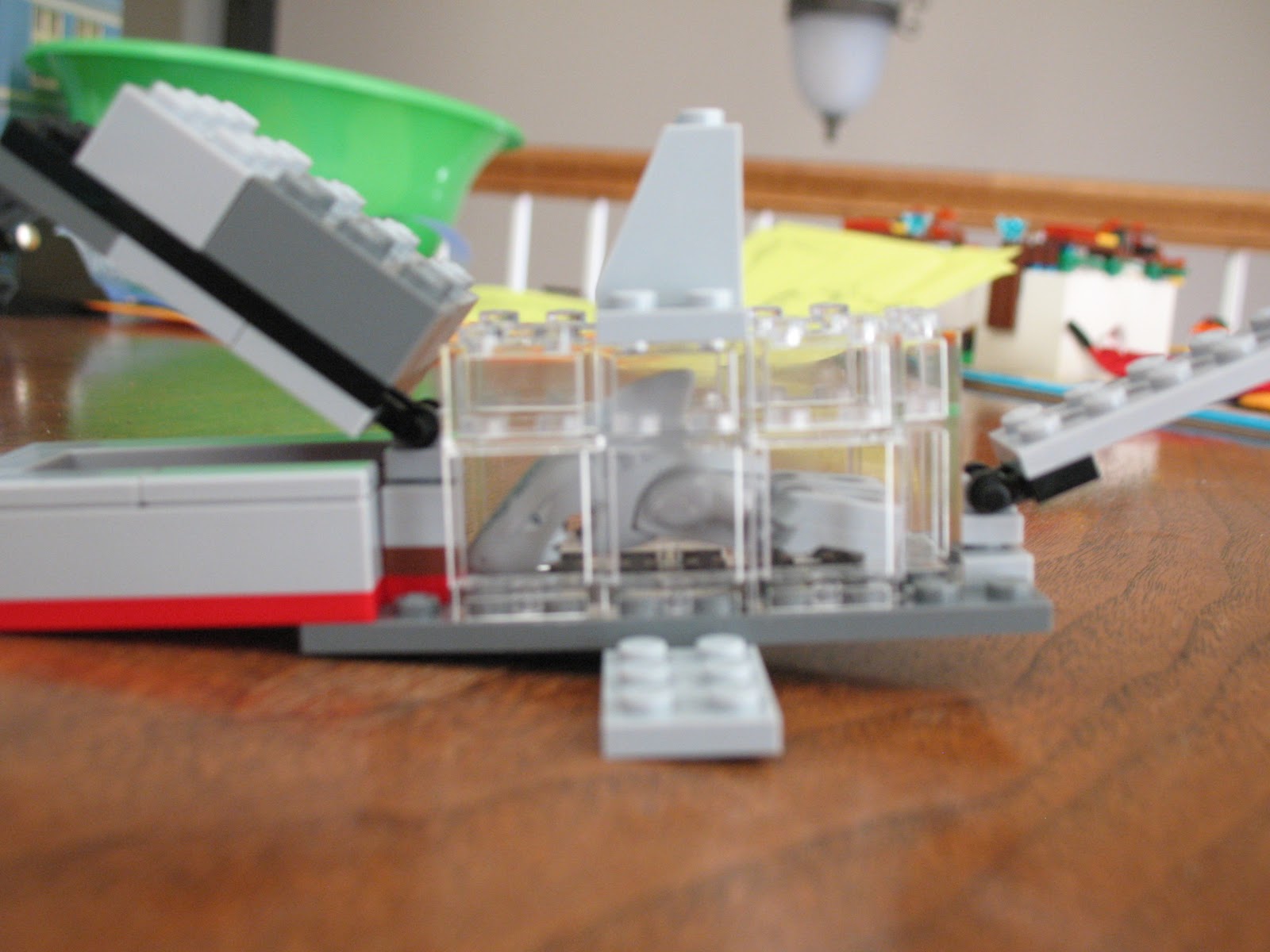
I am constantly amazed at the creativity my kids display. Here are a couple of their recent lego creations:
This is H's "Shark Mobile". Notice the clear compartment in which the shark-man can ride.
This is my middle son's "Roman villa" complete with a patio on which he can grill dinner.
Sunday, February 17, 2013
Gluten Free Lunches/Snacks
A while ago Kate at Gluten-Free Gobsmacked asked about the type of gluten free lunches people take to work, being tired of mainly salads herself. I sympathize with her plight as there are many times I would LOVE to be able to just grab something as I run out of the house and not have to plan ahead. So I was thrilled to see these GOPICNIC boxes at my local Target.
I first encountered GOPICNIC at a small airport when I was desperate for anything gluten-free. The GOPICNIC box I found was fun, delicious, and safe. Since then I have been asking all of the local grocery stores to carry them and I guess Target finally listened! I bought as many gluten free GOPICNIC varieties as they had in stock.
At this point I should qualify that I am only planning to use these in an emergency. At $4 a box, they are too expensive for me to use very often. But just knowing they are in the pantry makes it easier to plan a regular lunch-to-go.
And that brings me back to Kate's request: what do I plan for lunches? Here is a picture of some of my regular supplies:
The one I turn to most often is peanut-butter rice cake sandwiches (do not add jelly or honey to these; however nutella works well). A close second (not shown) is a scrambled egg-and cheese quasadilla. I also like to freeze fruit like peaches and berries when they are in season in muffin tins. Then I store them in gallon bags, for an easy addition to some homemade yogurt (the frozen fruit keeps the yogurt cool until lunchtime). My protein muffins are a favorite as well, but there are rarely enought leftover from breakfast to take for lunch. I also love to bring some soup or casserole in a thermos if there is any available. And with any lunch I add either some fresh or dried fruit, and maybe some nuts, cheese or pepperoni for an extra bit of protein if I am famished. If it is going to be an extra-long day I might throw in some chocolate milk or pineapple juice for a pick-me-up.
There are some occasions where I need to travel for a few days and I like to bring along a meal as a "just-in-case" provision. My favorites in those situations are Pacific's soups and ready rice, rice cakes and individual packages of peanut butter, and oatmeal with nuts/dried fruit.
As a final note I want to mention desserts. The longer I have been gluten-free and eating healthy, the less satisfied I am with the typical M&Ms or candy bars. So for a small bite of something sweet I take along a piece of quality dark chocolate or one of these fortune cookies. There is something about a ridiculous fortune that tops off a meal perfectly.
Happy gluten-free eating!
'Chelle
I first encountered GOPICNIC at a small airport when I was desperate for anything gluten-free. The GOPICNIC box I found was fun, delicious, and safe. Since then I have been asking all of the local grocery stores to carry them and I guess Target finally listened! I bought as many gluten free GOPICNIC varieties as they had in stock.
At this point I should qualify that I am only planning to use these in an emergency. At $4 a box, they are too expensive for me to use very often. But just knowing they are in the pantry makes it easier to plan a regular lunch-to-go.
And that brings me back to Kate's request: what do I plan for lunches? Here is a picture of some of my regular supplies:
The one I turn to most often is peanut-butter rice cake sandwiches (do not add jelly or honey to these; however nutella works well). A close second (not shown) is a scrambled egg-and cheese quasadilla. I also like to freeze fruit like peaches and berries when they are in season in muffin tins. Then I store them in gallon bags, for an easy addition to some homemade yogurt (the frozen fruit keeps the yogurt cool until lunchtime). My protein muffins are a favorite as well, but there are rarely enought leftover from breakfast to take for lunch. I also love to bring some soup or casserole in a thermos if there is any available. And with any lunch I add either some fresh or dried fruit, and maybe some nuts, cheese or pepperoni for an extra bit of protein if I am famished. If it is going to be an extra-long day I might throw in some chocolate milk or pineapple juice for a pick-me-up.
There are some occasions where I need to travel for a few days and I like to bring along a meal as a "just-in-case" provision. My favorites in those situations are Pacific's soups and ready rice, rice cakes and individual packages of peanut butter, and oatmeal with nuts/dried fruit.
As a final note I want to mention desserts. The longer I have been gluten-free and eating healthy, the less satisfied I am with the typical M&Ms or candy bars. So for a small bite of something sweet I take along a piece of quality dark chocolate or one of these fortune cookies. There is something about a ridiculous fortune that tops off a meal perfectly.
Happy gluten-free eating!
'Chelle
Friday, February 15, 2013
Progress (or not) with Integrated Listening
On the advice of H's therapist we started a program called "Integrated Listening". We have been doing the 1 hr of listening and the 15 minutes of exercise every day for the past three months. I had noticed some signs of maturity in H lately, but also times of high emotions. During the latest parent-teacher conference we were told that H's attention span in class is no better, and she has started to act out a bit more. Unfortunately all the news is bad this time.
So is the Integrated Listening not working? It is hard to say. First of all, the company says it takes 6 months before there are benefits. Second, we haven't actually been doing it every day, or doing the exercises every time we listen. It has taken us 2 months to get through 40 sessions because every time you miss a day you have to repeat a lesson (some lessons we repeated 4 times because we kept forgetting a day). Third, H is almost a preteen and might be experiencing some hormonal swings.
Our plan for now is to continue the listening program and the exercises. We will try to become more disciplined and do it exactly according to the instructions. We will continue to encourage H and help her the best we can with school. And we will pray, pray, and pray some more.
If anyone else has experience with Integrated Listening, good or bad, I would love to hear from you.
Thanks,
'Chelle
So is the Integrated Listening not working? It is hard to say. First of all, the company says it takes 6 months before there are benefits. Second, we haven't actually been doing it every day, or doing the exercises every time we listen. It has taken us 2 months to get through 40 sessions because every time you miss a day you have to repeat a lesson (some lessons we repeated 4 times because we kept forgetting a day). Third, H is almost a preteen and might be experiencing some hormonal swings.
Our plan for now is to continue the listening program and the exercises. We will try to become more disciplined and do it exactly according to the instructions. We will continue to encourage H and help her the best we can with school. And we will pray, pray, and pray some more.
If anyone else has experience with Integrated Listening, good or bad, I would love to hear from you.
Thanks,
'Chelle
Wednesday, February 13, 2013
Science (Physics) Valentines
I created these valentines for my physics class. You are welcome to print them off and use them as well. Please just link back to this site if you repost them elsewhere. The inspiration for these are the valentines cards at the evilmadscientist.com. However some of those were a bit much for high school students!
Sunday, October 28, 2012
Parent-teacher conference
We had our first school-wide parent/teacher conference day this past week. I went into it feeling pretty good, since H has brought all of her grades up to C, B, and even a few As.
So I was pretty shocked when the teacher told me H is not adjusting to 5th grade.
Her comments mainly seemed to center around the fact that H does not catch much from verbal instruction. And most of a classroom is verbal instruction. Her comment, which I thought was very accurate, was that H's mind is like a carosel, turning roung and round. She only catches what is said when the carosel of her mind is turned forward, which is seldom.
In the end, I was actually okay with the situation. We know H does not listen well. That is why we have started the Integrated Listening. And while the teacher is comparing H to the students around her, and seeing how far behind she is, we are comparing her to where she was 2 years ago and seeing how far she has come!
So I am still hopeful. We are continuing what we were doing, and at the same time telling H to make sure she completes her math and writes neater (two additional complaints the teacher had).
I will keep you up to date.
Chelle
So I was pretty shocked when the teacher told me H is not adjusting to 5th grade.
Her comments mainly seemed to center around the fact that H does not catch much from verbal instruction. And most of a classroom is verbal instruction. Her comment, which I thought was very accurate, was that H's mind is like a carosel, turning roung and round. She only catches what is said when the carosel of her mind is turned forward, which is seldom.
In the end, I was actually okay with the situation. We know H does not listen well. That is why we have started the Integrated Listening. And while the teacher is comparing H to the students around her, and seeing how far behind she is, we are comparing her to where she was 2 years ago and seeing how far she has come!
So I am still hopeful. We are continuing what we were doing, and at the same time telling H to make sure she completes her math and writes neater (two additional complaints the teacher had).
I will keep you up to date.
Chelle
Sunday, October 14, 2012
School again-good news!
H. is doing well at school! She has brought all of her grades up to a A or B with the exception of spelling, where she has (barely) a C. She is doing much better about writing down her assignments and completing her assignments, though I have to stay on top of her about that. She is still having trouble following verbal instruction at school, and still gets bored easily (maybe because she isn't understanding most things?). Because of this we are starting the Integrated Listening system which her therapist recommended. It was pricey, but it has the complete program which is about 2 years worth of therapy. And it isn't too hard. She listens to a program for an hour a day, and spends 15 minutes of that hour doing some exercises (one of which is a balance board, which she LOVES) and some time getting a massage. Other than that we just have to tell her she can't wrestle with her brothers while having this expensive equipment attached to her :-)
I'll keep you updated as to whether it seems to have any affect. One of the frustrating things about this and similar programs is it is hard to find reviews on them that aren't company sponsered. Maybe this blog will help.
'Chelle
I'll keep you updated as to whether it seems to have any affect. One of the frustrating things about this and similar programs is it is hard to find reviews on them that aren't company sponsered. Maybe this blog will help.
'Chelle
Saturday, September 15, 2012
Relief
I met with the substitute teacher, and she seems wonderful. She is very willing to work with us, and has been very helpful this week keeping me up to date at what H is not doing at school. Most of it seems to be not filling in the work required. I have to wonder how much of this is distraction and how much of this is laziness, since H hates to write. I think we need to start up the writing therapy again.
Tuesday, September 11, 2012
Roadbump
We have had a month of 5th grade at this point. Things started out rocky. H was missing assignments, wasn't studying, and in general was failing everything but math by week 2. However then I met with the teacher and explained how H does not understand verbal instructions well. We talked about what was expected, and I was able to pass that along to H after we got home. Things improved significantly after that, with Bs on tests and mostly passing homework (she forgot to turn in a few assignments and got a zero). But now the worst thing possible has happened. Due to tragic circumstances, her teacher is out for a while and H has a substitute. We ran into this back in 2nd grade. No matter how hard they try (and I think substitutes are saints to attempt what they do) substitutes cannot run the class the same way as the regular teacher. And H only does well when she knows what is coming up and what is expected. Again, she does not take verbal instructions well and therefore doesn't handle a change in the schedule very well. This past week has been a disaster. According to H she hasn't had any written assignments, reading was skipped twice, and math skipped once. And I cannot contact the sub by email or phone to double check any of this. I sincerely wish we had gone ahead with the integrated listening program during the summer. We will definately do it next summer, if not sooner!!!
My plan as of this point is to meet with the sub tomorrow after school to find out what is happening. And then I think I need to start calling some of the parents to check on some of H's claims about not needing to do some types of assignments.
Sunday, July 29, 2012
Crafts-part 2
Another project we started this summer was to make a bed for my son. Since he and the youngest share a room, they are in desperate need of space. But I really don't like loft beds or bunk beds. Both are hard to make and hard to get onto if you need to lay down with a child due to a nightmare. So we decided to get a bed that was high enough to put under it his BIG container of duplos as well as several of the large imaginex toy sets he has. But we couldn't find anything that was just right. So we went to anawhite.com and modified one of her plans to make this bed. It is high enough to put his toys underneath it, but low enough that he doesn't need a stool to get up or rails to keep him safe.
Before we ever tried this though, I wanted to see if I could actually build something. I started with the doll farmhouse bed from Ana White.
I was pleased with how it came out, so I tried a birdhouse for my son's scout project:
This made me realize I cannot just make things without a plan. It is functional, but just barely. The birds shunned it for the longest time (I think they only used it after all other possible nest building sites were taken).
However the bedside table I made for the youngest one turned out pretty well.
So with all of that experimentation done, I tackled the big bed. It took about two weeks, start to finish. It only cost about $125, which I was thrilled with. And when I was sick of the precision wood building demands (I prefer hobbies where I can make mistakes and still recover, like crochet or cooking), I made H some things to hang in her door (she previously had some plastic kite tails there):
This was ALOT easier to do and alot more relaxing. I just did a little bit here and there, as I had time and energy.
Since school is about to start again, I think I will stick with small, easy to do projects for a while. My son needs a bedside table for his big bed, H is asking for another stuffed animal, and she needs a simple desk for her room. That should keep me busy for a while.
I hope your summer was fun too!
'Chelle
Saturday, July 28, 2012
Crafts-part 1
We have had a wonderful summer. We ended up not doing the Integrated Listening therapy, due to financial reasons. But H has still done well. She does get wild if she gets sugar, but that is about it. We have also been doing some homework, and she seems to remember her school skills. I am hopeful for next year, but a bit anxious as well. I am planning on meeting with her teacher (once I know who he/she is) and explaining H to her. I am praying for a good year.
Off the topic of H: I wanted to show off some of the projects I have done in the past year. I learned how to crochet about a year and a half ago. This was done to combat the frustration and boredom of having to sit next to H for hours to keep her on track with her homework every night. Here are some of the projects I have made: amigurumi animals for the kids, a scarf, a purse, and several amigurumi pokemon for H.
Thursday, May 24, 2012
Finishing up
Today is the last day of 4th grade for H. We met with her teacher last week. H is going on to 5th grade, and even better, made all As and Bs the last quarter.
I feel like we are almost done with our journey through ADHD. We are still going to do auditory exercises for H to help her in that area, and are still going to keep her on a low sugar diet. But overall she is now behaving like a normal child. At the end of the year her teacher and classmates all said that the words that describes H best are joy and love. She has such a joy of life, is a joy to be with, and loves almost everyone. This is such a huge contrast to the child she became while on ADHD medicine. I can't tell you how thankful I am to God that we found this therapy, how thankful I am for H's therapist, and how thankful I am for H's teacher who supported us in our journey to help H without medication.
Since we are basically done with this ADHD journey, this blog will now morph into a more normal one. From time to time I am sure I will give you an update on H, but mostly I will be blogging about any fun recipes or projects I do. I hope you enjoy it!
'Chelle
I feel like we are almost done with our journey through ADHD. We are still going to do auditory exercises for H to help her in that area, and are still going to keep her on a low sugar diet. But overall she is now behaving like a normal child. At the end of the year her teacher and classmates all said that the words that describes H best are joy and love. She has such a joy of life, is a joy to be with, and loves almost everyone. This is such a huge contrast to the child she became while on ADHD medicine. I can't tell you how thankful I am to God that we found this therapy, how thankful I am for H's therapist, and how thankful I am for H's teacher who supported us in our journey to help H without medication.
Since we are basically done with this ADHD journey, this blog will now morph into a more normal one. From time to time I am sure I will give you an update on H, but mostly I will be blogging about any fun recipes or projects I do. I hope you enjoy it!
'Chelle
Saturday, April 28, 2012
Gluten free German Chocolate Cake
This recipe is adapted from David Lebovitz's german chocolate cake recipe. It is so moist, so delicious! The best chocolate cake I have ever had. Next time I might decrease the amount of sugar by 1/4 C though. We don't tend to go for really sweet stuff. I didn't use David's recipe for coconut filling, mostly because I was out of cream. So I used the recipe in Crazy about Cupcakes for coconut filling, and everyone loved it.
German Chocolate Cake
2 oz bittersweet chocolate
2 oz unsweetened chocolate
6T water
8oz butter, unsalted
1C sugar
4 egg yolks
1/2 C each of oat flour, tapioca flour, rice flour and buckwheat flour
1/4 C flax meal
1 t baking powder
1 t baking soda
1 1/2 t salt
1C yogurt
1 t vanilla
4 egg whites and 1/4 C sugar
Preheat oven to 350 degrees. Butter and flour (I used cocoa powder) two 9 inch round cake pans.
Melt the chocolate and water together. Let cool.
Beat the butter and sugar together until light yellow and fluffy. Add in chocolate and then the egg yolks.
Mix the flours, flax, baking powder, baking soda, and salt together. Mix in the chocolate and the yogurt/vanilla in batches until smooth.
Beat the egg whites and sugar until double volume. Fold into the batter. Pour batter into cake pans and bake 45 minutes.
Coconut Filling:
one can evaporated milk
1 1/2 cups sugar
3/4 cup butter
4 egg yolks
1 1/2 t vanilla
2 C coconut
1 C chopped nuts (we used walnuts)
Combine the milk, sugar, butter, egg yolks and vanilla in a saucepan. Stir constantly over medium heat until thickened and golden brown (this took forever).
Toast the coconut and nuts in a 350 degree oven. Mix in with cooled carmelized mixture.
Chocolate Icing:
8 oz chocolate bittersweet
2T corn syrup
1 1/4 oz butter
2/3 C cream
Combine the chocolate, corn syrup, butter in a bowl. Heat the cream until boiling, then pour it over the chocolate mix. Let it sit one minute, then stir until smooth.
To put together:
On top of one cake layer spread the coconut filling. Place other cake over it. Spread the rest of the coconut filling on the top. Spread the icing around the sides.
You won't regret making this cake!
Chelle
German Chocolate Cake
2 oz bittersweet chocolate
2 oz unsweetened chocolate
6T water
8oz butter, unsalted
1C sugar
4 egg yolks
1/2 C each of oat flour, tapioca flour, rice flour and buckwheat flour
1/4 C flax meal
1 t baking powder
1 t baking soda
1 1/2 t salt
1C yogurt
1 t vanilla
4 egg whites and 1/4 C sugar
Preheat oven to 350 degrees. Butter and flour (I used cocoa powder) two 9 inch round cake pans.
Melt the chocolate and water together. Let cool.
Beat the butter and sugar together until light yellow and fluffy. Add in chocolate and then the egg yolks.
Mix the flours, flax, baking powder, baking soda, and salt together. Mix in the chocolate and the yogurt/vanilla in batches until smooth.
Beat the egg whites and sugar until double volume. Fold into the batter. Pour batter into cake pans and bake 45 minutes.
Coconut Filling:
one can evaporated milk
1 1/2 cups sugar
3/4 cup butter
4 egg yolks
1 1/2 t vanilla
2 C coconut
1 C chopped nuts (we used walnuts)
Combine the milk, sugar, butter, egg yolks and vanilla in a saucepan. Stir constantly over medium heat until thickened and golden brown (this took forever).
Toast the coconut and nuts in a 350 degree oven. Mix in with cooled carmelized mixture.
Chocolate Icing:
8 oz chocolate bittersweet
2T corn syrup
1 1/4 oz butter
2/3 C cream
Combine the chocolate, corn syrup, butter in a bowl. Heat the cream until boiling, then pour it over the chocolate mix. Let it sit one minute, then stir until smooth.
To put together:
On top of one cake layer spread the coconut filling. Place other cake over it. Spread the rest of the coconut filling on the top. Spread the icing around the sides.
You won't regret making this cake!
Chelle
Thursday, April 26, 2012
A first!
Wow, we had a breakthrough today! H actually realized that I had missed an item when packing up her backpack for school. This has never happened before. I can hardly believe how much more mature she is!
That said, I think the only thing left to really work on is her auditory short term memory. When doing the word recall list, she can still only get 5 words consistantly; sometimes 6. That is WAY below age level, and we can't seem to move up. I think we will just keep doing the same exercises for this last month of school, and then during the summer try something new.
We also had her birthday party recently, and I made a gluten-free german chocolate cake that came out delicious! Better than any german chocolate cake I have had before. I will try to post the recipe soon.
Hope you are enjoying this beautiful spring!
Chelle
That said, I think the only thing left to really work on is her auditory short term memory. When doing the word recall list, she can still only get 5 words consistantly; sometimes 6. That is WAY below age level, and we can't seem to move up. I think we will just keep doing the same exercises for this last month of school, and then during the summer try something new.
We also had her birthday party recently, and I made a gluten-free german chocolate cake that came out delicious! Better than any german chocolate cake I have had before. I will try to post the recipe soon.
Hope you are enjoying this beautiful spring!
Chelle
Monday, April 16, 2012
Back again
I'm sorry I have been gone so long. There were several reasons: we had received information about H that I wanted to see which way it would go (more below), my several part-time jobs collided and I was extremely stressed for a while, and my kids were driving me crazy (probably due to the preceding problem).
Anyway, what happened with H was that her teacher met with us to tell us that H was not doing 4th grade work and would have to repeat 4th grade unless she started doing better. By better, she meant that H needed to write in complete sentences, write in pencil, not crayon or marker, and fill in the whole worksheet, not just the first 3 questions. I couldn't argue with her. And I decided that if she said H needed to stay behind a year, we would do it.
The problem was that I wasn't sure if H was not doing the work because of inability to focus or because of laziness. Her therapist thought it might be both. To counter the latter, we started doing writing exercises as part of the therapy; to help with the former we continued the oral memory work. The therapist suggested we use Integrated listening systems, which we still might do. However the price is a bit more than we can afford just yet.
Part of what started me thinking that it was laziness was a comment H made about not wanting to work as hard for things she found boring. So for the next few weeks we continued to talk about having to put forth just as much effort in the boring, tedious stuff as in the interesting, fun stuff. She acted like that was a concept she had never thought of before. Go figure! H was also very motivated by the thought of not staying with her friends in 5th grade.
All that was a month ago.
I just heard from her teacher a few days ago. H has made significant improvements, to the point that "we don't have to worry about her" anymore. Thank God! She will make it to 5th grade. I was very proud of her.
Of course she still has to continue doing good work in ALL areas, not just fun ones. And we are still continuing the therapy exercises. But there is now a light at the end of the tunnel! I can't believe we have made it this far!
'Chelle
Anyway, what happened with H was that her teacher met with us to tell us that H was not doing 4th grade work and would have to repeat 4th grade unless she started doing better. By better, she meant that H needed to write in complete sentences, write in pencil, not crayon or marker, and fill in the whole worksheet, not just the first 3 questions. I couldn't argue with her. And I decided that if she said H needed to stay behind a year, we would do it.
The problem was that I wasn't sure if H was not doing the work because of inability to focus or because of laziness. Her therapist thought it might be both. To counter the latter, we started doing writing exercises as part of the therapy; to help with the former we continued the oral memory work. The therapist suggested we use Integrated listening systems, which we still might do. However the price is a bit more than we can afford just yet.
Part of what started me thinking that it was laziness was a comment H made about not wanting to work as hard for things she found boring. So for the next few weeks we continued to talk about having to put forth just as much effort in the boring, tedious stuff as in the interesting, fun stuff. She acted like that was a concept she had never thought of before. Go figure! H was also very motivated by the thought of not staying with her friends in 5th grade.
All that was a month ago.
I just heard from her teacher a few days ago. H has made significant improvements, to the point that "we don't have to worry about her" anymore. Thank God! She will make it to 5th grade. I was very proud of her.
Of course she still has to continue doing good work in ALL areas, not just fun ones. And we are still continuing the therapy exercises. But there is now a light at the end of the tunnel! I can't believe we have made it this far!
'Chelle
Saturday, February 18, 2012
Another month
Things have finally settled down again. It seemed to take H forever to get adjusted to her new exercises this time. Part of it was my fault, as I was not as consistent as usual at the beginning. I finally had to realize that I simply couldn't get all of them done every night. So I took off two of the exercises and what is left is doable most nights. She isn't complaining (much) about them and does them with a good attitude. Her grades in school continue to be good, with lots of As and Bs and a few C/Ds. More importantly, her teacher said she is doing really well (with the exception of last week when she was fighting a cold and not feeling well).
However something happened a few weeks ago that left me feeling blindsided. The school called one day saying a parent had complained that H hurt her daughter on the bus; from what H said it sounds like they got too boisterous in playing. Then another parent complained a week later that H hit her son; again it seems not to be anything meanspirited. And because of this H was not going to be allowed to ride the bus! I have no problem acknowledging that H was wrong and too wild and needed to stop. Which I must point out she did. From what several people said it sounds like what really was happening is that H tends to be too boisterous and loud all the time on the bus (like many of the other kids there) and the bus driver was looking for a reason to put her off. Mind you, this was only the second time the school had contacted me about a bus problem with H. For all I knew, things were fine most of the year. If they had contacted me sooner at least we could have worked on the problem before it got to this point. I feel like this is a similar thing to what happened with scouts last year. For some reason people seem to feel like they have to pretend everything is under control until it has worn them down so much that they can't take your child any more in any situation.
And I am preaching to myself as well. I teach 3 yr sunday school and have had some problem children as well. Also I know how frustrating and tiring yet charming H can be. She is a handful. So while I understand to some extent how the bus driver feels, I still wish he had approached me earlier (which I had requested after the first incident) so that we could have worked on this. Yet I know he is a caring person who did his best. I am afraid this is not the last time we will have something like this with H, especially in situations that have lots of stimulation or are different from what she is used to.
However something happened a few weeks ago that left me feeling blindsided. The school called one day saying a parent had complained that H hurt her daughter on the bus; from what H said it sounds like they got too boisterous in playing. Then another parent complained a week later that H hit her son; again it seems not to be anything meanspirited. And because of this H was not going to be allowed to ride the bus! I have no problem acknowledging that H was wrong and too wild and needed to stop. Which I must point out she did. From what several people said it sounds like what really was happening is that H tends to be too boisterous and loud all the time on the bus (like many of the other kids there) and the bus driver was looking for a reason to put her off. Mind you, this was only the second time the school had contacted me about a bus problem with H. For all I knew, things were fine most of the year. If they had contacted me sooner at least we could have worked on the problem before it got to this point. I feel like this is a similar thing to what happened with scouts last year. For some reason people seem to feel like they have to pretend everything is under control until it has worn them down so much that they can't take your child any more in any situation.
And I am preaching to myself as well. I teach 3 yr sunday school and have had some problem children as well. Also I know how frustrating and tiring yet charming H can be. She is a handful. So while I understand to some extent how the bus driver feels, I still wish he had approached me earlier (which I had requested after the first incident) so that we could have worked on this. Yet I know he is a caring person who did his best. I am afraid this is not the last time we will have something like this with H, especially in situations that have lots of stimulation or are different from what she is used to.
Subscribe to:
Posts (Atom)